🌿 Accompagnement corporel & coaching relationnel en tango – séances en anglais.



Why tango?
12/17/20252 min read
Argentine tango probably sounds very sexy and seductive. For that we can thank mainstream media like movies, that present tango as something dramatic, full of love and hate, game of domination and seducing. The truth, however, is quite different.
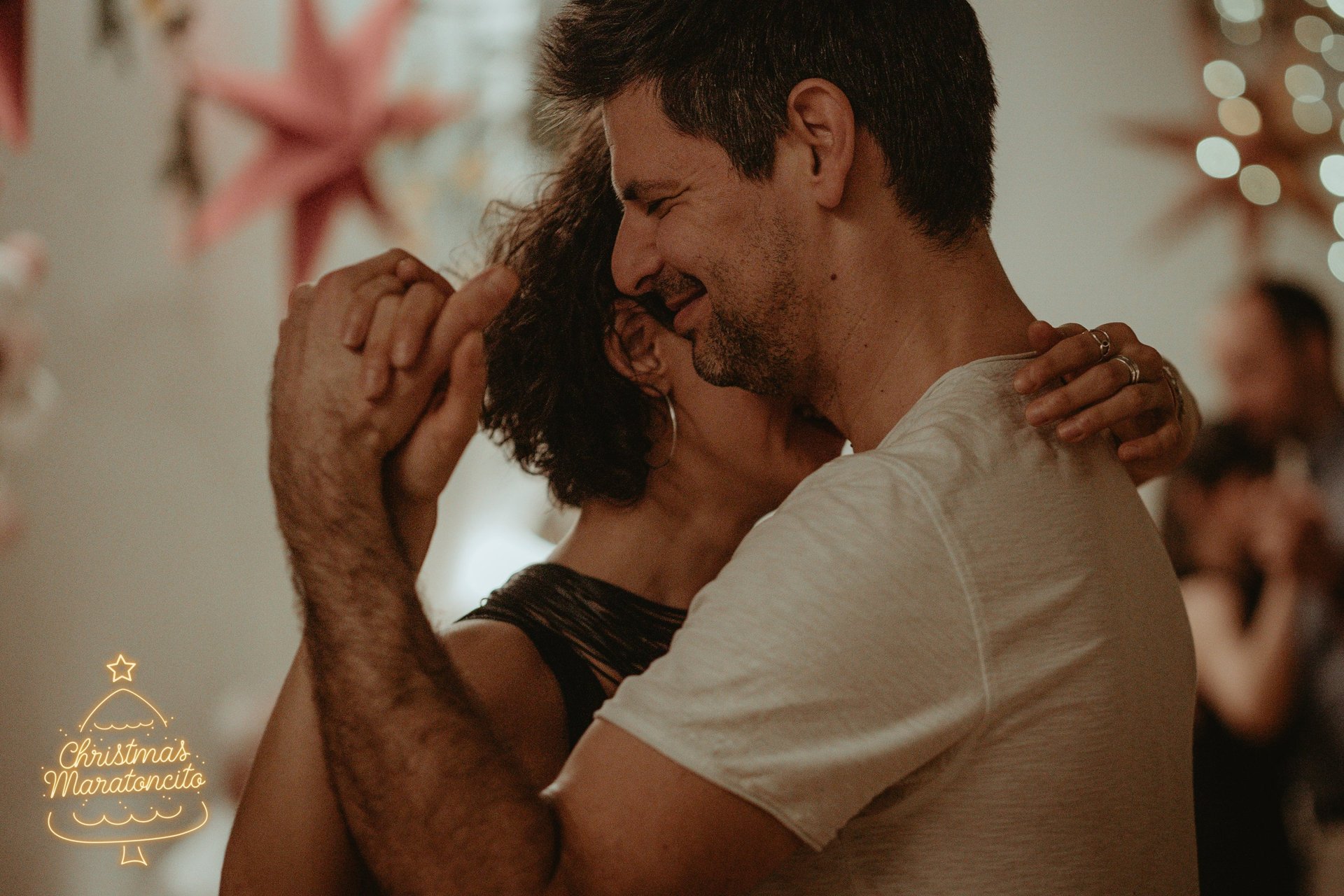
Argentine tango, as I teach it and nourish, is a social dance in which the emphasis is not on exhibitionist movements, visual spectacle, nor does the beauty of it measurs by how sexy the slit in a tanguera’s dress is. Tango can certainly be aesthetically beautiful and interesting to the eye of a casual observer, but good tango is always an inner experience, felt only by the people who are dancing it. What people fall in love with when they start tango is precisely that inner feeling of connection and nonverbal communication with a partner.
If a couple is connected on the inside, their connection will inevitably be what captures attention from the outside, regardless of how virtuose their movements are. Without that connection, even the most complex figures and technically perfect movements can feel empty—both internally and externally.
What does it mean to be a connected on the inside? The question of connection (a word we often use in tango) is about complete attunement between partners, when a couple moves so harmoniously that the sense of physical boundaries between them disappears. The inner experience in such moments is one of deep understanding, freedom, and belonging at the same time, along with an energetic sense of merging with another person. Two bodies become one, even if the partners have just met for the first time in their lives.
Tango is danced for oneself and for one’s partner. In the context of social dance, it is not oriented outward, toward an audience, but exclusively toward the feeling we share with a another. That is why simple steps and movements may sometimes look boring from the outside, while on the inside they are often a fireworks of sensations.
Tango is often thought of as highly sexual, and this is sometimes the reason people hesitate to embark on this adventure. In reality, tango is much more sensual. It asks you to feel even the smallest movements and sensations of your body—movements as subtle as the expansion of your ribs as you inhale. Through tango, you get to know your body on a micro level, bringing a great deal of awareness to its specific parts. This is why tango is sometimes described as meditation for two. Of course, like any physical discipline, tango has its biomechanical principles and will ask you to teach your body new movements, turning it into an ally even in the most challenging situations.
Through tango, we learn what it means to have a sense of control and surrender at the same time, since the entire dance is based on improvisation and neither partner can ever know for certain what the next step will be. If we allow ourselves to surrender to this game, it becomes incredibly fun.
Tango offers us a learning space grounded in a solid structure, making it easier to master. But after some time, I will encourage you to deconstruct everything you know and create your own dance. Like learning a foreign language—once you master the form, you can use the words you’ve learned to create art.
Above all, tango teaches us attention, listening to one another, understanding and respecting each other. It teaches us to communicate in a new way. It is a game without boundaries, in which everyone wins.
And that is why tango.
© 2026 Tango Garden
Shortcuts